Home/Raccoons
Raccoon Removal in Tuscaloosa
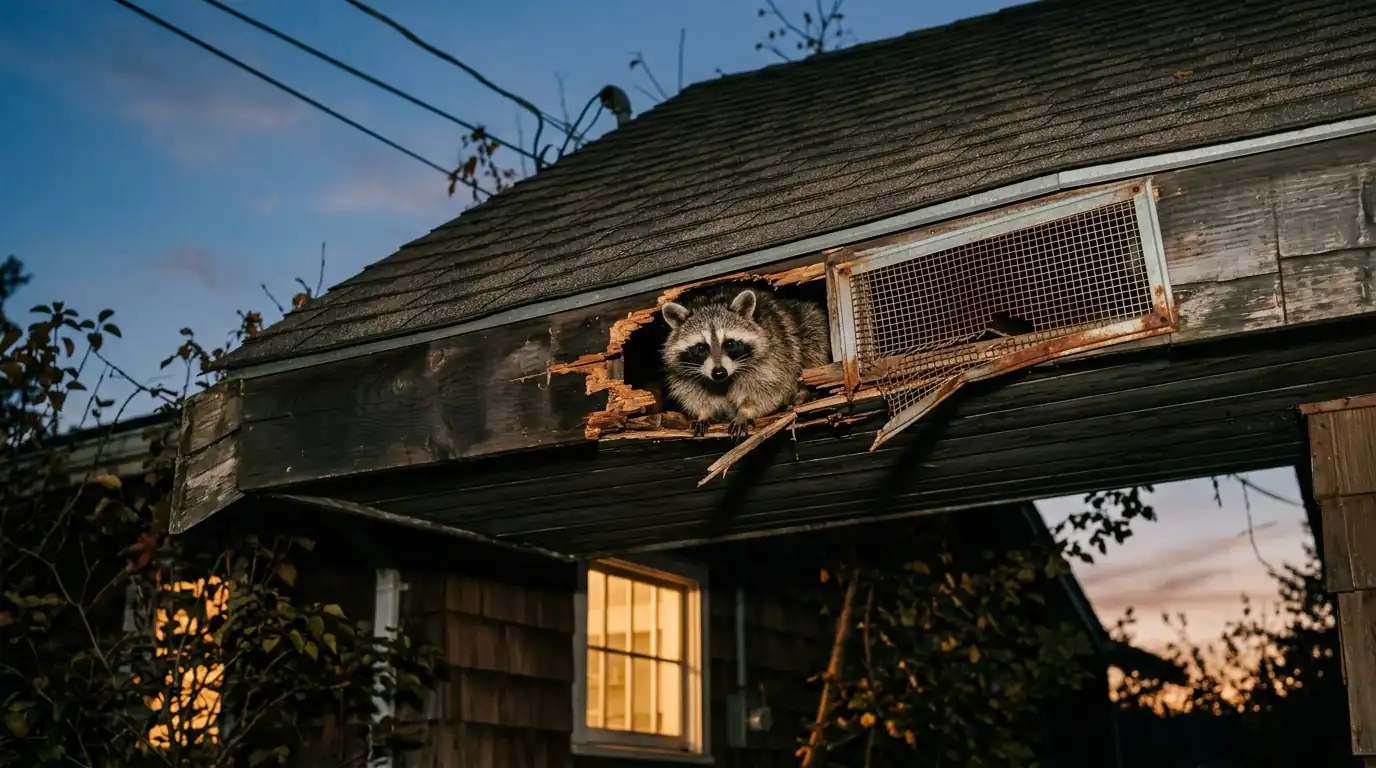
Raccoons tear their own way in, which is why they do more damage to a house than most animals that get inside one.
Rental housing is the local complication. A raccoon in an owner-occupied house gets noticed in days; the same raccoon in a rental can go a full semester, because the person hearing it is not the person who pays for the roof and the person who pays for the roof is not there to hear it. By the time it is reported the damage is rarely just an entry hole.
Raccoons in Tuscaloosa County: who does what
Alabama’s wildlife division does not remove nuisance wildlife from private property unless public safety is at risk. It permits Nuisance Wildlife Control Operators to do it instead, and the state’s own wording is that they do so at the landowner’s or tenant’s expense. In a city where a very large share of the housing is rented, that last phrase is not academic; it is the argument that delays the job while the animal keeps chewing, so settle who is paying early.
For identifying an animal or damage before anyone is paid to look, the Alabama Cooperative Extension, Tuscaloosa County office is at 1800 McFarland Blvd E #342, Tuscaloosa, AL 35404, (205) 349-4630 (office page).
What Alabama law says about raccoons
Under Alabama regulation 220-2-.27 a property owner or tenant may take one raccoon per damage incident without a permit; beyond that, a permit from the Department of Conservation is needed, and anyone running a wildlife control business needs one. Raccoons have no closed season (2026-27) and no bag limit on private land. A live-caught animal may not be moved across a county line or a major river drainage. ADPH says raccoons make up most of Alabama’s rabies cases every year. All Alabama rules →
Sources: Ala. Admin. Code r. 220-2-.27 (Cornell LII); Alabama WFF: raccoon season; Alabama Department of Public Health: rabies; Outdoor Alabama, Nuisance Animal Control. Checked October 2026.
Signs, and why they matter
- Heavy, deliberate footsteps overhead: raccoons are big enough to sound like a person walking
- Chittering, growling or the distinctive cry of kits, usually at dusk or just before dawn
- A torn soffit, lifted shingles, or a ripped roof or gable vent
- Rabies: raccoons are a primary rabies vector across the southeastern United States
- Raccoon roundworm (Baylisascaris) in the droppings, which is dangerous to people and pets
How removal works
A licensed operator finds every entry point, removes the animal, and critically any kits, which are usually hidden in a wall cavity or soffit and cannot leave on their own, then seals the openings with materials a raccoon cannot tear off. Sealing before the young are out is the most common and most expensive mistake.
Raccoon questions
How much does raccoon removal cost in Tuscaloosa?
$300 – $600 for removal; far more if the attic needs restoring, depending on access and whether young are present. After a long stay in an attic the cleanup is often the bigger bill (attic restoration).
Is there a wrong time of year to deal with raccoons?
Spring is the worst time to trap and seal: females den in attics to give birth, and removing the mother while kits remain leaves them to die inside the structure.
Request a quote
We read every request and pass it to a licensed wildlife operator covering Tuscaloosa where one is available. We are still building our list of operators here, so we cannot promise one is available or say how quickly they will respond.